Augmented and virtual reality in education: A comparative study of teacher perceptions in Saudi Arabia and Jordan
Article Sidebar
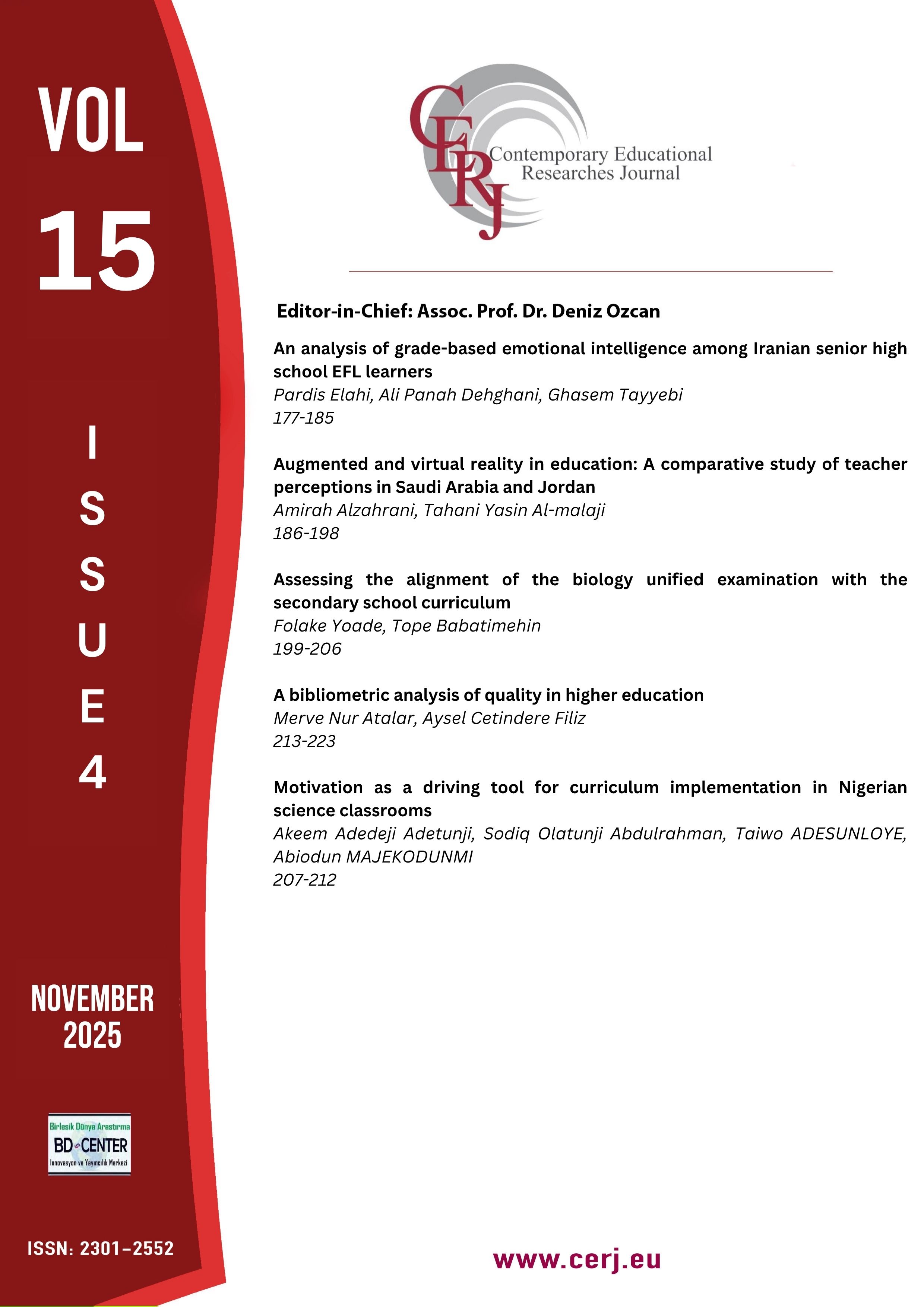
Main Article Content
Abstract
This study explores teachers’ perceptions of augmented reality and virtual reality as emerging instructional tools in public schools. It addresses a research gap concerning educators’ readiness and attitudes toward integrating immersive technologies into classroom practice. The objective was to understand how teachers perceive the educational value of these technologies and whether their perspectives vary according to professional experience and academic qualification. Adopting a descriptive survey design, data was collected from 199 teachers using a validated instrument. The analysis indicated a moderate level of familiarity and application of augmented and virtual reality in teaching practices. Differences in perception were observed across experience levels and educational backgrounds. The findings suggest that despite growing awareness, the pedagogical integration of these technologies remains limited by insufficient training and institutional support. The study underscores the importance of professional development programs and policy initiatives to enhance teachers’ competence and confidence in utilizing immersive tools for innovative learning.
Keywords: Augmented reality; education; teachers; technology integration; virtual reality
Downloads
Article Details

This work is licensed under a Creative Commons Attribution-NonCommercial-NoDerivatives 4.0 International License.
Authors who publish with this journal agree to the following terms:
- Authors retain copyright and grant the journal right of first publication with the work simultaneously licensed under a Creative Commons Attribution License that allows others to share the work with an acknowledgement of the work's authorship and initial publication in this journal.
- Authors are able to enter into separate, additional contractual arrangements for the non-exclusive distribution of the journal's published version of the work (e.g., post it to an institutional repository or publish it in a book), with an acknowledgement of its initial publication in this journal.
- Authors are permitted and encouraged to post their work online (e.g., in institutional repositories or on their website) prior to and during the submission process, as it can lead to productive exchanges, as well as earlier and greater citation of published work (See The Effect of Open Access).