
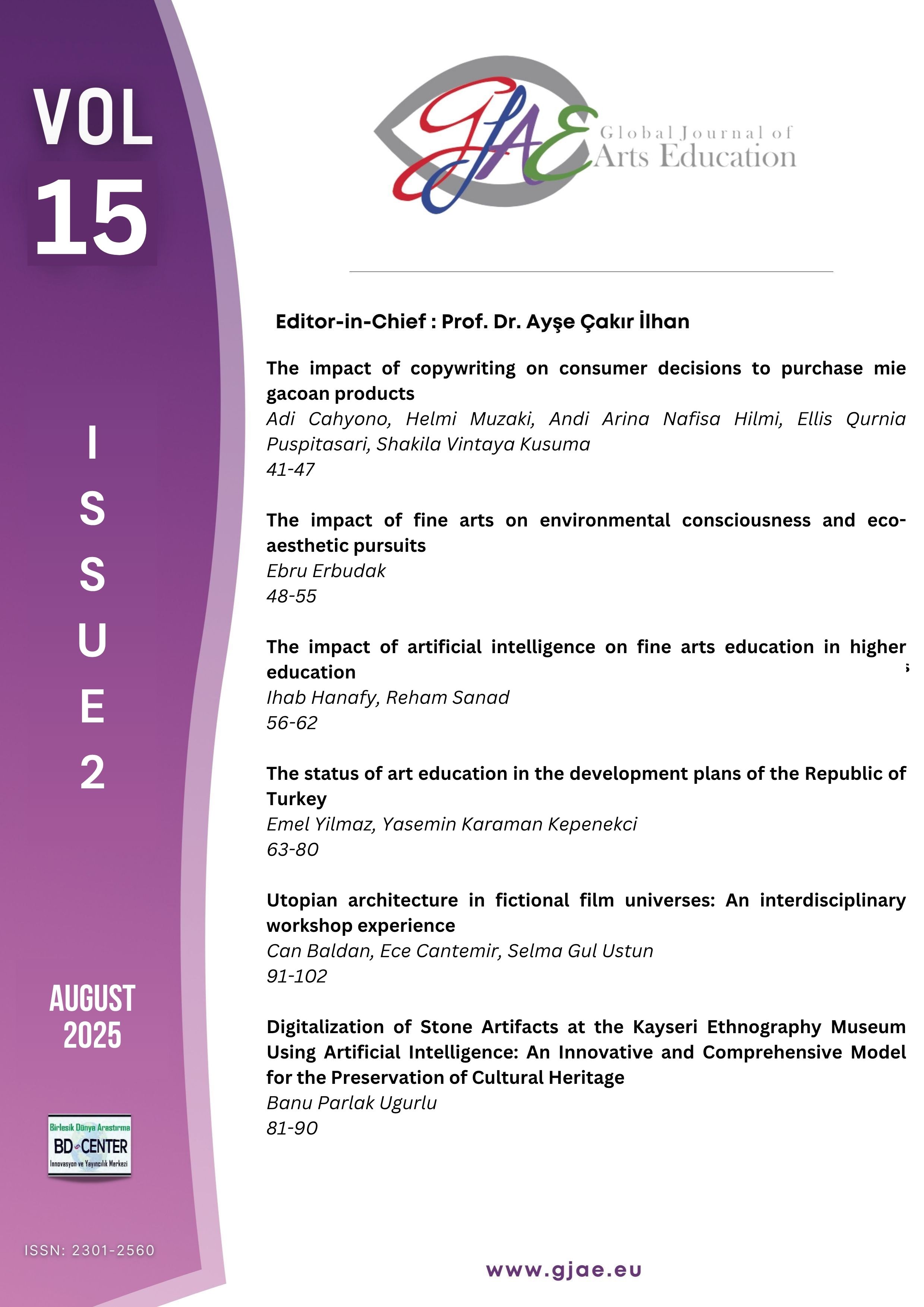
The impact of artificial intelligence on fine arts education in higher education
Article Sidebar
Main Article Content
Abstract
The integration of artificial intelligence into fine arts education presents both opportunities and challenges for specialised art academies, particularly as technological advancements increasingly influence creative disciplines. While research has explored artificial intelligence in general education and design fields, limited studies have examined its specific impact on fine arts education and the pedagogical strategies of art academies. This study aims to investigate the influence of artificial intelligence on fine arts education and to evaluate its advantages and limitations within specialised academic settings. The study employed a qualitative approach, analysing the conceptual definitions of artificial intelligence, its key applications in art and design, and the educational role of art academies in cultivating students’ artistic skills and appreciation. The findings indicate that artificial intelligence offers innovative tools for artistic creation and design, enhancing learning processes and expanding creative possibilities. At the same time, the cultivation of artistic appreciation remains central to the mission of art academies, providing students with critical skills that differentiate them in the creative domain. The study highlights that while artificial intelligence can augment educational practices, the foundational role of fostering aesthetic sensitivity and critical artistic engagement is essential for maintaining the distinctive value of fine arts education.
Keywords: Artificial intelligence; art education; creative skills; fine arts.
Downloads
Article Details
Authors who publish with this journal agree to the following terms:
- Authors retain copyright and grant the journal right of first publication with the work simultaneously licensed under a Creative Commons Attribution License that allows others to share the work with an acknowledgement of the work's authorship and initial publication in this journal.
- Authors are able to enter into separate, additional contractual arrangements for the non-exclusive distribution of the journal's published version of the work (e.g., post it to an institutional repository or publish it in a book), with an acknowledgement of its initial publication in this journal.
- Authors are permitted and encouraged to post their work online (e.g., in institutional repositories or on their website) prior to and during the submission process, as it can lead to productive exchanges, as well as earlier and greater citation of published work (See The Effect of Open Access).