
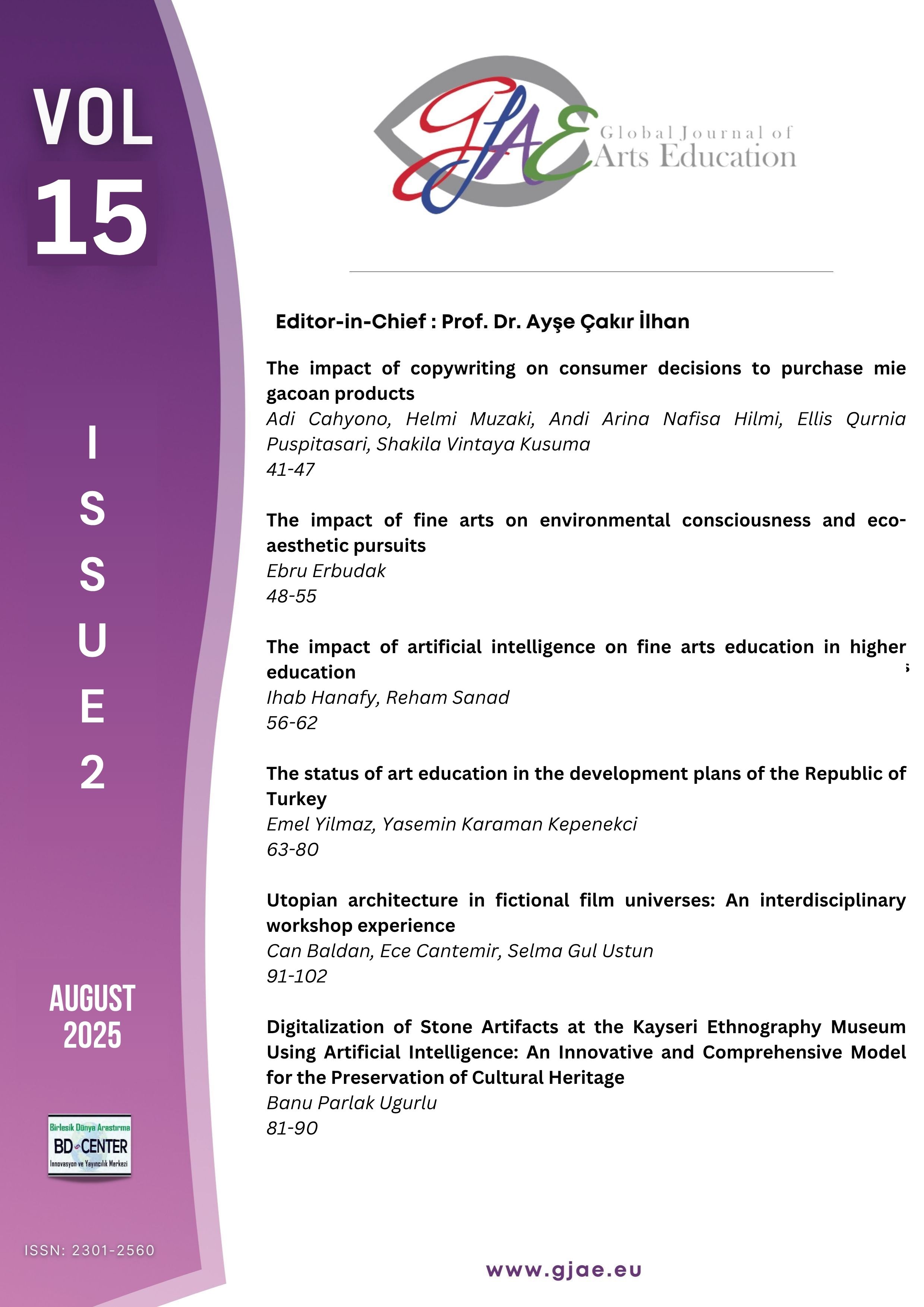
The status of art education in the development plans of the Republic of Turkey
Article Sidebar
Main Article Content
Abstract
Arts education plays a significant role in fostering cultural awareness, creativity, and social development within educational systems, while also contributing to broader economic and social progress. Despite its recognized importance, limited research has systematically examined how arts education is positioned within national development planning and whether strategic objectives are supported by practical policy frameworks. This study aims to examine the extent to which arts education is incorporated into national development plans and to analyze the roles attributed to arts education within these policy documents. The research employs a qualitative design using document analysis. The study materials consist of 12 development plans obtained from the official website of the Presidency of Strategy and Budget. Data were analyzed through content analysis using the MAXQDA program to identify recurring themes and policy orientations. The findings indicate that arts education is framed in relation to cultural identity, value transmission, institutional development, and economic contribution. In addition, arts education is presented as a strategic component for social integration and the development of qualified human capital. However, the analysis also reveals that policy objectives are frequently not supported by clearly defined implementation strategies. The study highlights the need for stronger institutional mechanisms and policy frameworks to enhance the practical integration of arts education within educational and social development agendas.
Keywords: Arts education; cultural policy; development planning; educational policy; qualitative research
Downloads
Article Details
Authors who publish with this journal agree to the following terms:
- Authors retain copyright and grant the journal right of first publication with the work simultaneously licensed under a Creative Commons Attribution License that allows others to share the work with an acknowledgement of the work's authorship and initial publication in this journal.
- Authors are able to enter into separate, additional contractual arrangements for the non-exclusive distribution of the journal's published version of the work (e.g., post it to an institutional repository or publish it in a book), with an acknowledgement of its initial publication in this journal.
- Authors are permitted and encouraged to post their work online (e.g., in institutional repositories or on their website) prior to and during the submission process, as it can lead to productive exchanges, as well as earlier and greater citation of published work (See The Effect of Open Access).