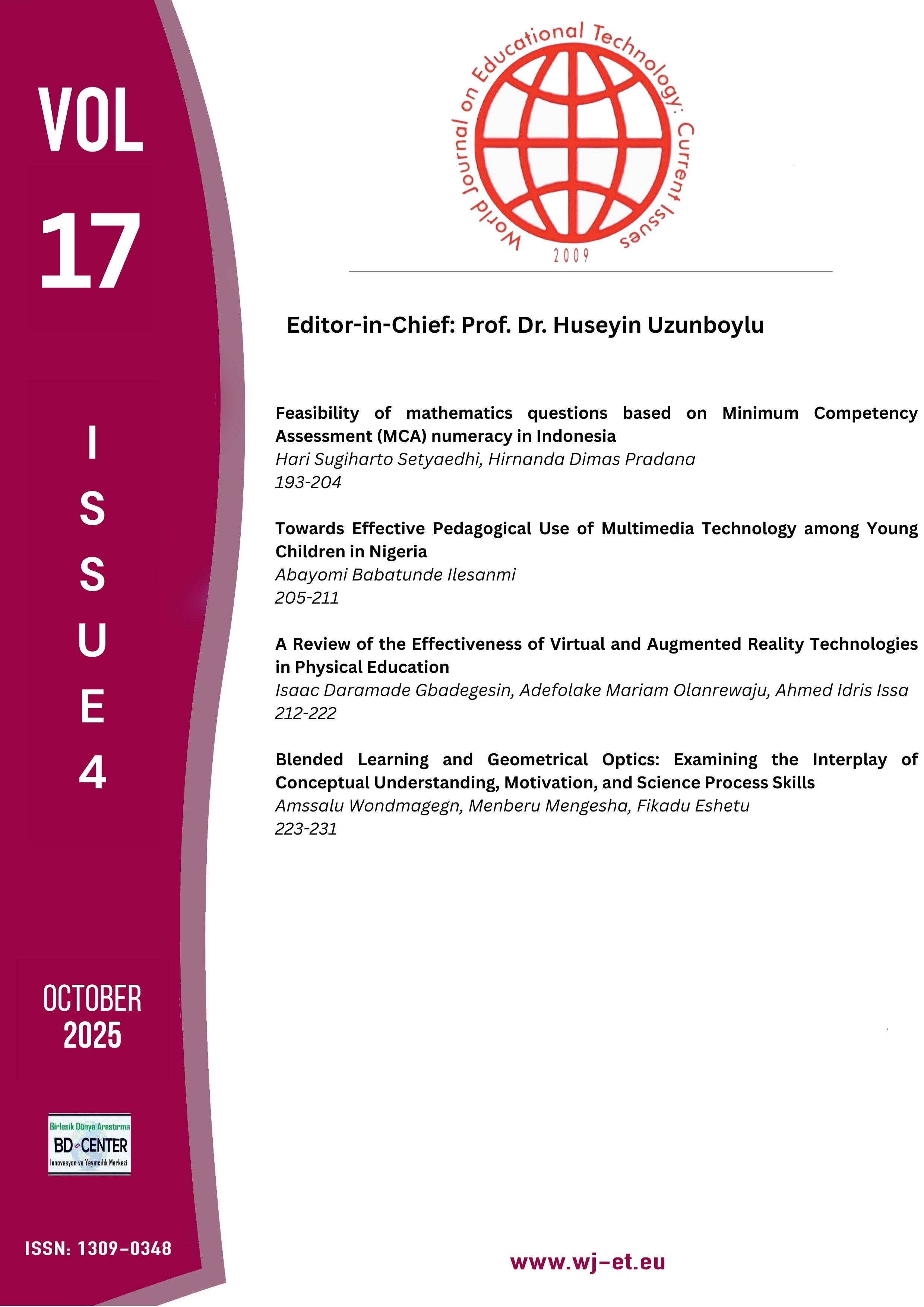
A Review of the Effectiveness of Virtual and Augmented Reality Technologies in Physical Education
Article Sidebar
Main Article Content
Abstract
The integration of pedagogical practice with digital technology is revolutionizing physical education through the adoption of virtual reality (VR) and augmented reality (AR). Immersive technologies have been applied in various learning settings to increase motivation, engagement, and motor skill learning. Nevertheless, despite their increased application, there is a shortage of systematic reviews to analyze their effectiveness in physical education. The aim of this study is to synthesize existing empirical evidence on the use of VR/AR technologies in physical education, discussing their advantages and disadvantages, and identifying areas that have limited research. Literature review was undertaken systematically employing the Publish or Perish (PoP) software to search for pertinent research in Google Scholar. The parameters set were limited to peer-reviewed, 2020-2024 published journals using specific keywords related to VR/AR technologies in physical education and sports training contexts.. The studies were chosen on the basis of empirical design, motor skill development focus, and game-based learning approaches. The final round included research carried out using commercial VR/AR software and locally developed interactive programs. The studies categorized studies according to intervention duration, technology, participants, and outcome measured. The review identified a succession of studies that had established the increases in motor capability, motivation, and interest achieved through VR/AR-enabled physical education. VR environments added to full-body motion control, response, and balance, and AR device-enhanced visualization and execution of motor skills. Game-based VR/AR applications proved most effective among all categories of applications in maximizing learner interest and learning retention. Nonetheless, pertinent limitations were described, such as accessibility barriers, equipment cost, and transfer in reliability of motor skills in a virtual environment to actual use. In addition, the majority used quasi-experimental studies, with which it is challenging to evaluate cause-and-effect. Comparative research between AR effectiveness and VR does not exist. VR and AR technology offer exciting possibilities for extension of physical education in the areas of heightened motivation and motor skills acquisition. However, broader use of the technologies is limited by expense and logistical considerations. Studies should address how to surmount these, boil instructional design down to its essence, and clarify the long-term impact of VR/AR on physical education.
Keywords: Virtual Reality, Augmented Reality, Physical Education, Immersive Technologies, Learning Outcomes, Student Engagement
Downloads
Article Details

This work is licensed under a Creative Commons Attribution 4.0 International License.
World Journal on Educational Technology: Current Issues is an Open Access Journal. The copyright holder is the author/s. Licensee Birlesik Dunya Yenilik Arastirma ve Yayincilik Merkezi, North Nicosia, Cyprus. All articles can be downloaded free of charge. Articles published in the Journal are Open-Access articles distributed under CC-BY license [Attribution 4.0 International (CC BY 4.0)].
Birlesik Dunya Yenilik Arastirma ve Yayincilik Merkezi (BD-Center)is a gold open-access publisher. At the point of publication, all articles from our portfolio of journals are immediately and permanently accessible online free of charge. BD-Center articles are published under the CC-BY license [Attribution 4.0 International (CC BY 4.0)], which permits unrestricted use, distribution, and reproduction in any medium, provided the original authors and the source are credited.