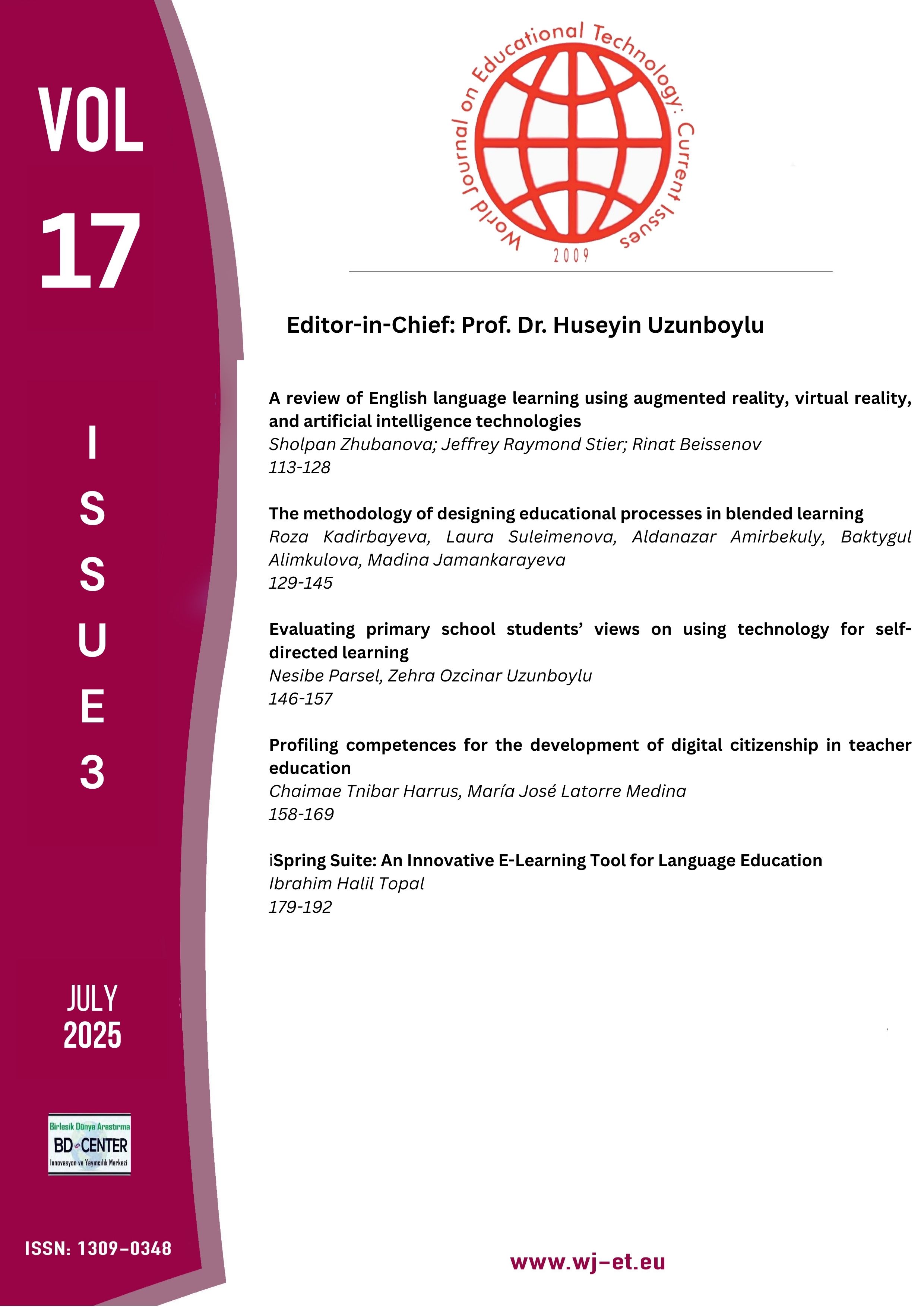
Evaluating primary school students’ views on using technology for self-directed learning
Article Sidebar
Main Article Content
Abstract
This study investigates primary school students’ perspectives on their self-learning capabilities through the use of technology, addressing the growing emphasis on learner autonomy in digital learning environments. Despite increasing integration of technology into education, limited research has explored how students at early grade levels perceive and develop self-learning skills using technological tools. To address this gap, a descriptive survey model was employed, involving 120 students from a private primary school. Data were collected using a demographic information form and a validated scale measuring technology-assisted self-learning, and were analyzed using independent samples t-tests and frequency analysis via statistical software. Findings revealed no significant differences in self-learning abilities based on gender. However, a significant variation was observed across grade levels, with fifth-grade students demonstrating higher self-learning proficiency with technology compared to fourth-grade students. These results suggest that as students’ progress through primary education, their ability to engage in autonomous learning with technological support improves. The findings underscore the importance of scaffolding self-directed learning skills from early grades and suggest implications for curriculum design that promotes technology-enabled autonomy in learning.
Keywords: Digital learning; primary education; self-directed learning; student perception; technology integration
Downloads
Article Details

This work is licensed under a Creative Commons Attribution 4.0 International License.
World Journal on Educational Technology: Current Issues is an Open Access Journal. The copyright holder is the author/s. Licensee Birlesik Dunya Yenilik Arastirma ve Yayincilik Merkezi, North Nicosia, Cyprus. All articles can be downloaded free of charge. Articles published in the Journal are Open-Access articles distributed under CC-BY license [Attribution 4.0 International (CC BY 4.0)].
Birlesik Dunya Yenilik Arastirma ve Yayincilik Merkezi (BD-Center)is a gold open-access publisher. At the point of publication, all articles from our portfolio of journals are immediately and permanently accessible online free of charge. BD-Center articles are published under the CC-BY license [Attribution 4.0 International (CC BY 4.0)], which permits unrestricted use, distribution, and reproduction in any medium, provided the original authors and the source are credited.