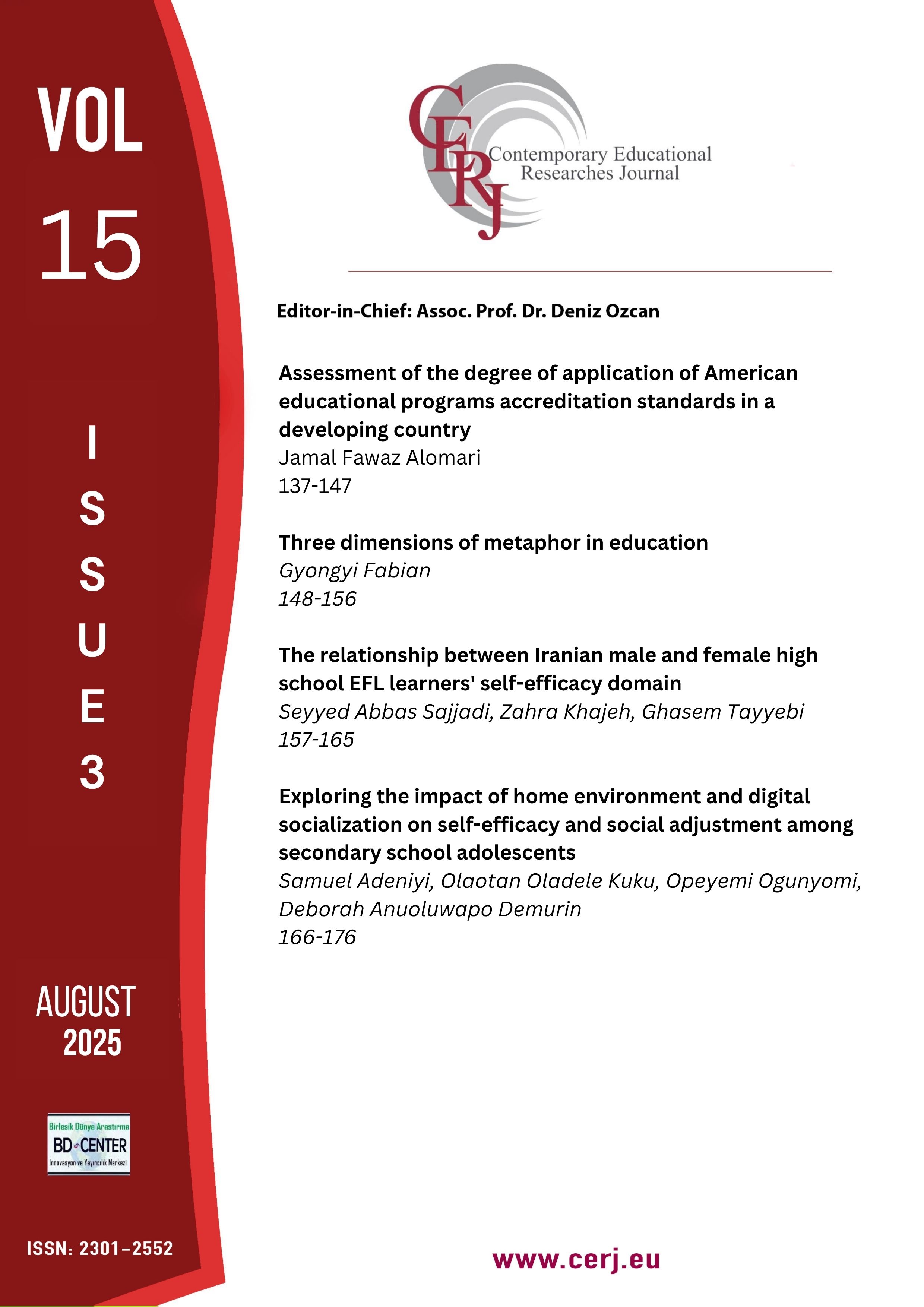
Exploring the impact of home environment and digital socialization on self-efficacy and social adjustment among secondary school adolescents
Article Sidebar
Main Article Content
Abstract
The study investigated how home factors and digital socialization influence self-efficacy and social adjustment among secondary school adolescents. The research was motivated by the growing concern about adolescents’ adaptive functioning in an increasingly digital society and the limited understanding of how family environments interact with online experiences to shape developmental outcomes. A descriptive survey research design was adopted, involving 558 adolescents selected through a multi-stage sampling process. Validated instruments were used to assess home environment, digital socialization, self-efficacy, and social adjustment. Data were analyzed using descriptive and inferential statistics. Findings revealed that both home factors and digital socialization significantly contributed to adolescents’ self-efficacy and social adjustment. The results emphasized the importance of supportive home environments and responsible digital engagement in promoting adolescents’ confidence and social competence. The study provides insights for educators, parents, and policymakers on fostering healthy digital behaviors and enhancing family support systems to strengthen adolescents’ psychosocial development.
Keywords: Adolescents; digital socialization; home environment; self-efficacy; social adjustment.
Downloads
Article Details

This work is licensed under a Creative Commons Attribution-NonCommercial-NoDerivatives 4.0 International License.
Authors who publish with this journal agree to the following terms:
- Authors retain copyright and grant the journal right of first publication with the work simultaneously licensed under a Creative Commons Attribution License that allows others to share the work with an acknowledgement of the work's authorship and initial publication in this journal.
- Authors are able to enter into separate, additional contractual arrangements for the non-exclusive distribution of the journal's published version of the work (e.g., post it to an institutional repository or publish it in a book), with an acknowledgement of its initial publication in this journal.
- Authors are permitted and encouraged to post their work online (e.g., in institutional repositories or on their website) prior to and during the submission process, as it can lead to productive exchanges, as well as earlier and greater citation of published work (See The Effect of Open Access).