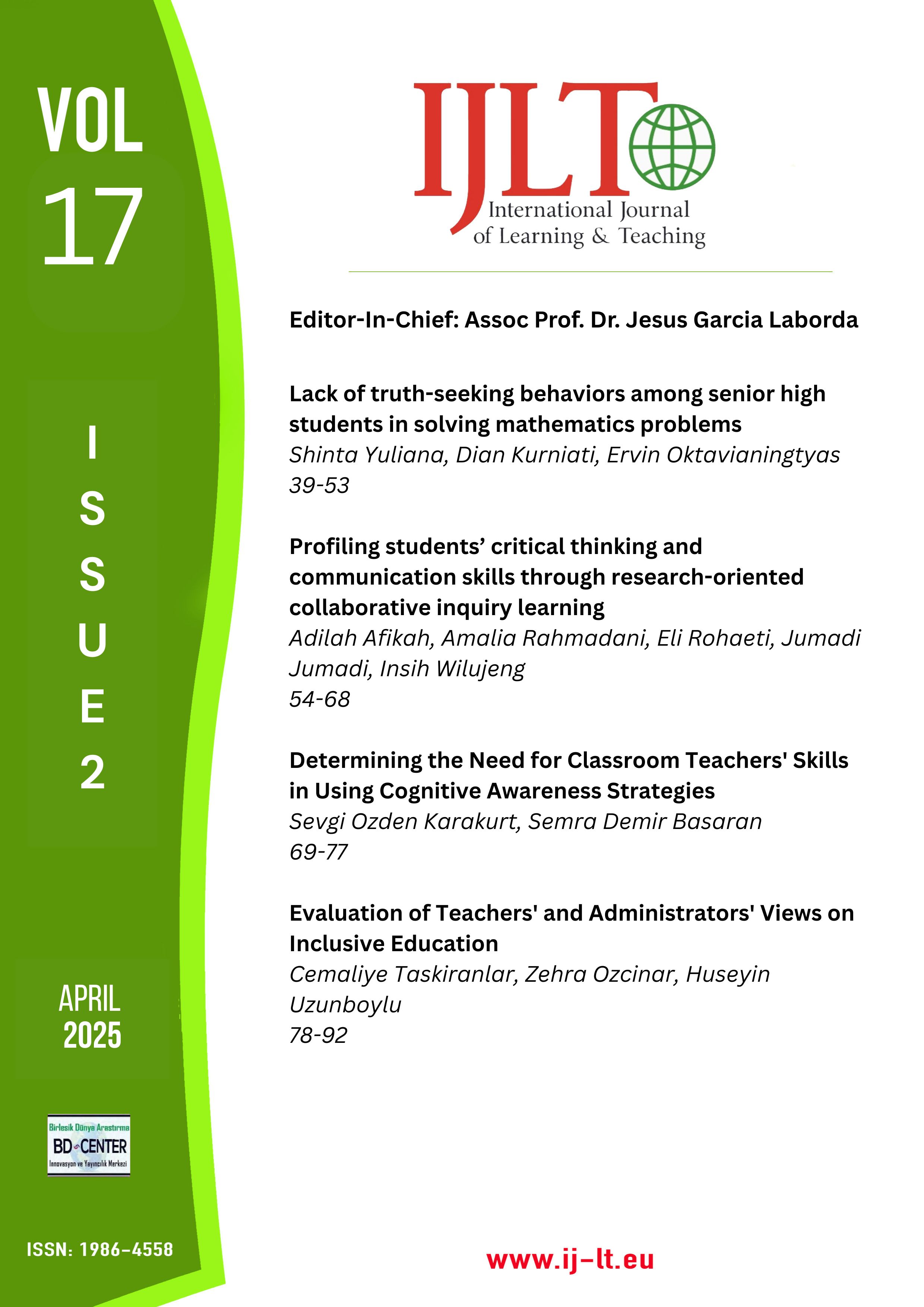
Determining the Need for Classroom Teachers' Skills in Using Cognitive Awareness Strategies
Article Sidebar
Main Article Content
Abstract
This study, stems from the need to explore teachers' requirements for about integrating cognitive awareness strategies into competencies. The research adopts a mixed-methods approach, employing three data collection tools. Qualitative nature tools are a structured observation form and a semi-structured interview form. The qualitative data obtained were analysed using descriptive analysis techniques. Quantitative data were collected by administering the Educational Metacognitive Regulation Inventor were analysed using descriptive statistical techniques in the SPSS software. Findings revealed that classroom teachers rarely utilised cognitive awareness strategies in their teaching environments and had limited knowledge about cognitive awareness strategies and were unaware of their importance in instructional settings. The findings of this study highlights the need for classroom teachers to use cognitive awareness strategies. They are expected to serve as a guide for designing professional development activities.
Keywords: cognitive awareness strategies; classroom teachers; professional development
Downloads
Article Details

This work is licensed under a Creative Commons Attribution-NonCommercial-NoDerivatives 4.0 International License.
Authors who publish with this journal agree to the following terms:
- Authors retain copyright and grant the journal right of first publication with the work simultaneously licensed under a Creative Commons Attribution License that allows others to share the work with an acknowledgement of the work's authorship and initial publication in this journal.
- Authors are able to enter into separate, additional contractual arrangements for the non-exclusive distribution of the journal's published version of the work (e.g., post it to an institutional repository or publish it in a book), with an acknowledgement of its initial publication in this journal.
- Authors are permitted and encouraged to post their work online (e.g., in institutional repositories or on their website) prior to and during the submission process, as it can lead to productive exchanges, as well as earlier and greater citation of published work (SeeThe Effect of Open Access).